The veto question · Published Sept. 23, 2026 · Updated Oct. 6
Oct. 6 The City signed and published Ordinance 26-48 without presenting it to the Mayor and lists it as effective Oct. 1. It has given three different reasons, in sequence. The DDA board asked the City Attorney for the legal basis; the office asked for five days and has not answered in two weeks. What has happened since →
Every ordinance goes to the Mayor. The City says this one won't.
The City Charter says every ordinance Council passes is presented to the Mayor, who can veto it, and it lists the only exceptions. Dissolving a DDA is not one of them. The City Attorney's office says the ordinance dissolving the Old Colorado City DDA will not go to the Mayor, on the reasoning that the Mayor had no veto power over the ordinance that created it. But he did. In August 2024 the City presented that ordinance to Mayor Mobolade, and he signed it. Both signature pages are below.
On Sept. 22 City Council passed Ordinance 26-48, dissolving the Old Colorado City DDA, by a vote of 5 to 4. Whether Mayor Mobolade can veto it turns on one sentence of the Charter and two pieces of paper.
What the Charter says
- “Every ordinance finally passed by the Council shall be presented to the Mayor within forty-eight hours thereafter for final adoption. If the Mayor approves such ordinance, he or she shall finally adopt it by signing it within five days after receiving it. If the Mayor disapproves, the ordinance shall be returned to the Council within five days with the Mayor's objections in writing. If then six (6) of the members vote to pass the same over the Mayor's veto, it shall become a finally adopted ordinance, notwithstanding the objections of the Mayor.”City Charter § 3-70(e)
- “Notwithstanding the foregoing subsections, the Mayor shall not have power to disapprove by veto the following listed types of ordinances, this limitation applying only to the following specifically identified ordinances: an ordinance accomplishing any quasi-judicial act; an ordinance approving bonds to be issued by any City enterprise; an ordinance pertaining to article VI, ‘Utilities,’ of this Charter; an ordinance submitting a Charter amendment to a vote of the qualified electors; or an ordinance proposing a Charter convention.”City Charter § 3-70(e)(2)
Five kinds of ordinance are exempt, and the Charter says the list applies “only to the following specifically identified ordinances.” City Code § 1.2.108 repeats the same list. Neither mentions downtown development authorities, special districts, or a category called “Council actions.”
The state DDA statute says a city may create or dissolve an authority “by ordinance of the governing body.” It does not say how a home-rule city enacts an ordinance. The Charter does.
What the City Attorney's office says
The City Attorney's office has told Council that the ordinance dissolving the DDA will not be presented to the Mayor. Its position, as United Westside understands it, is that the Mayor had no veto authority under state statute, the Charter, or City Code over the 2024 ordinance that created the DDA and sent it to the voters, and that for the same reason he has none over the ordinance dissolving it. The office describes dissolution as a Council action.
The position, as relayed to us, cites no section of the Charter, the Code, or the statute. Its reasoning rests on the 2024 ordinance: if the veto did not apply then, it cannot apply now.
What the record shows
The City keeps a signed copy of every ordinance on its Legistar site. Here is the last page of Ordinance 24-87, the ordinance that created the Old Colorado City DDA and sent it to the voters, and the last page of Ordinance 26-31, the ordinance Council passed this July correcting the DDA's boundaries.
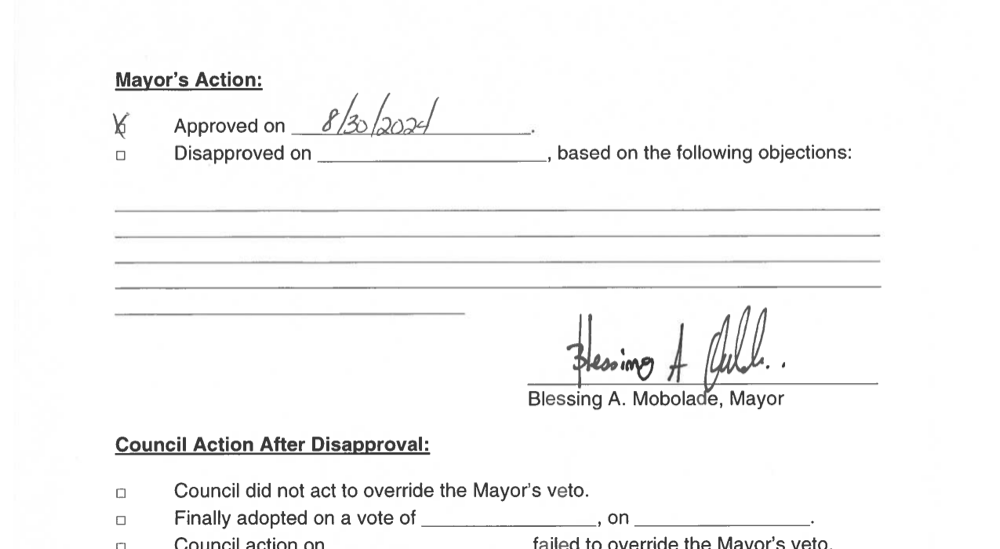
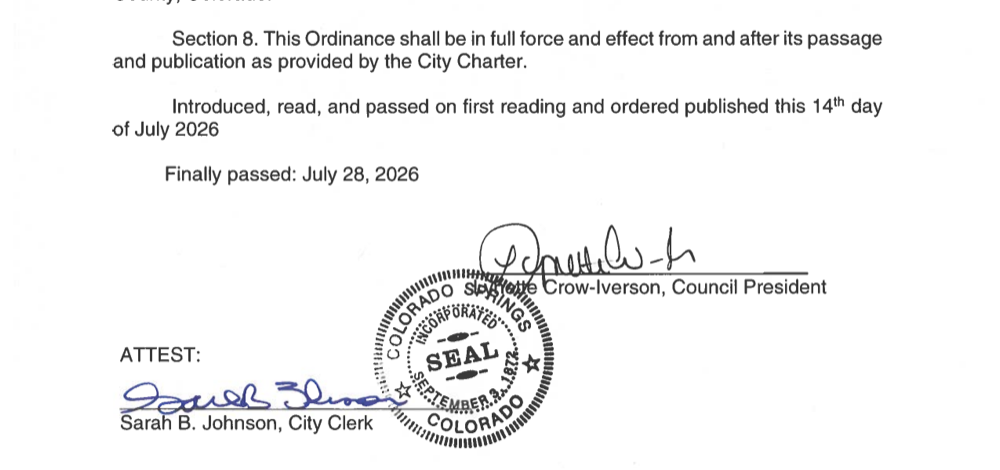
The 2024 ordinance went to the Mayor
The City presented the ordinance creating the DDA to Mayor Mobolade within the Charter's 48 hours, and he approved it three days after Council's final vote, inside the Charter's five days. The form has a checkbox for “Disapproved on,” lines for his objections, and a block for Council to override. That is the veto process, applied to this DDA, by this administration, in 2024.
Ordinance 26-31 acts under the same statute, for the same DDA, and its own Section 6 declares that it “bears a rational relationship to the legislative object sought to be obtained,” the standard language of a legislative act. It was not presented to the Mayor.
The decision was made before the vote
The draft of Ordinance 26-48 that Council voted on Sept. 22 has two signature lines: the Council President and the City Clerk. There is no Mayor's Action block. Whoever prepared the ordinance had decided it would not go to the Mayor before Council took its final vote. The draft as attached to the agenda.
Council passed the ordinance on Sept. 22. The Charter's 48-hour window for presenting it to the Mayor ran through Sept. 24. It was not presented. See below.
What has happened since
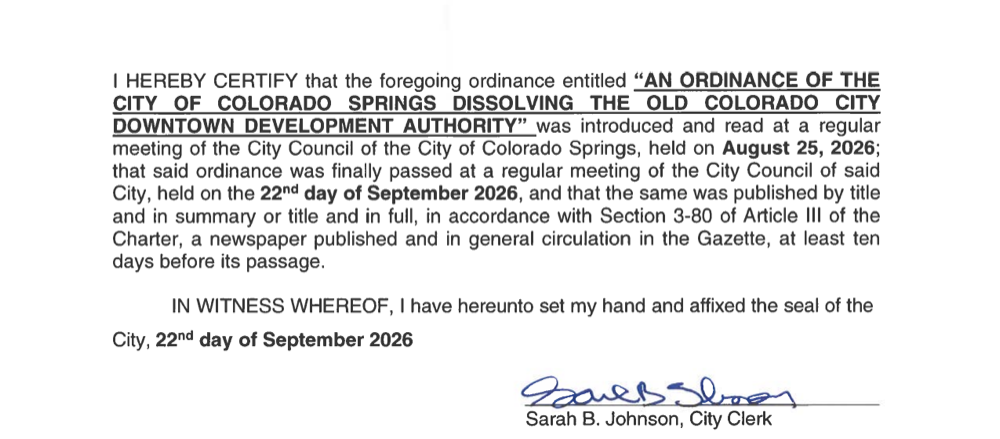
The ordinance was published as law without going to the Mayor
The Charter says an ordinance takes effect five days after its second publication, which follows “its final adoption according to section 3-70(e).” Section 3-70(e) gives three ways an ordinance is finally adopted: the Mayor signs it, Council overrides his veto, or he lets five days pass “after receiving it.” None of the three happened. The City published it anyway and lists it as effective Oct. 1.
The City's reasons, in the order it gave them
KKTV asked the City why the ordinance did not go to the Mayor and reported three answers.
- It was a resolution, not an ordinance. It is an ordinance. The City acknowledged this.
- The Mayor was not involved in the ordinance that created the DDA. He signed it. The page above shows his signature. KKTV sent the City the same record.
- State law gives dissolution to the governing body, and the Mayor is not part of it. The City's written statement to KKTV: “Under state law, dissolution authority is specifically vested in the governing body, which for Colorado Springs is the City Council. Once the statutory requirements for dissolution are met, state law assigns that decision to the City Council by ordinance. Because the Mayor is not part of the governing body, the dissolution ordinance is not subject to mayoral veto.”
The third reason is the first one with a theory in it, so it deserves an answer. The same statute gives the creation of a DDA to the governing body, by ordinance, in the same words. Ordinance 24-87 created this DDA under that statute, and the City presented it to the Mayor, who approved it. If the Mayor's absence from “the governing body” put dissolution beyond his reach, it put creation beyond his reach too. The City did not think so in 2024.
More basically, the statute says what a city may do. The Charter says how this city enacts an ordinance, and every ordinance it enacts passes through the Mayor unless the Charter's own list says otherwise. KKTV read the statute and found nothing about the Mayor.
What the DDA was told
According to the DDA board, its chair and its counsel asked the City Attorney's office in writing for the legal basis for withholding the ordinance. The office asked for five days to respond. As of Oct. 6, about two weeks later, it has not responded.
On the record
- “There is no category that seems to cover this and it should go to his desk.”Councilmember Dave Donelson, to KKTV
- “Were we wrong when it went to his desk the first time? Are we wrong now? It just doesn't seem to make sense to me.”Councilmember Dave Donelson, to KKTV
- “The fact that this ordinance was signed into policy by the mayor himself should be very clear that it needs to go to him for dissolution.”Adam Stepan, DDA board chair, to KKTV
The DDA board's position, as its chair told KKTV, is that an ordinance adopted outside the Charter's procedure has not been adopted, and that the DDA is therefore not dissolved. The board is considering whether to ask a district court to say so.
Every signed ordinance since the DDA was created
We checked all 63 signed ordinances the City has posted from May 2024 through this month for the Mayor's Action block.
- 27 have it. Code amendments, budget and appropriation ordinances, the dissolution of two advisory boards, the appointment of the City Attorney, and Ordinance 24-87 creating this DDA.
- 17 are zoning and annexation ordinances without it. Those are quasi-judicial, which the Charter exempts.
- 8 are Colorado Springs Utilities matters without it. Article VI of the Charter exempts those.
- 4 are business improvement district boundary changes without it, in late 2024. Each was a property owner's petition with published notice and a public hearing, and each ordinance “grants the Petition.” That is a quasi-judicial act, and the exemption fits.
- 1 filled vacancies on a BID board this month, without it. An appointment.
- 2 are the Old Colorado City DDA ordinances of 2026: the July boundary correction, and now the dissolution. Neither is quasi-judicial. Neither involves Utilities, bonds, or the Charter. Both were initiated by Council, with legislative findings and no petition or hearing.
Once the exempt categories are set aside, the only ordinances the City has kept from the Mayor without a reason the Charter recognizes are the two 2026 ordinances about this DDA. The 2024 ordinance about this DDA went to him. A BID petition ordinance and the BID appointment ordinance are here so the comparison can be checked.
Questions the City should answer
- Which section of the Charter, the Code, or the statute exempts Ordinance 26-48 from § 3-70(e)? The City has now cited the DDA statute's “governing body” language. That language also governed the 2024 ordinance the Mayor signed.
- Why was Ordinance 24-87 presented to the Mayor in 2024 if the Mayor had no authority over it? The signed page says he approved it.
- Who decided that 26-48 would not be presented, and when? The draft Council voted on already lacked the Mayor's signature block.
- Has the Mayor asked for the ordinance? The Charter says it shall be presented to him. It does not say the City Attorney decides whether he receives it. Two weeks on, his office has said nothing in public.
We don't know the answers. These are questions, not accusations. If the City provides authority for its position, we will publish it here.
What you can do
The Mayor can still settle this himself by asking for the ordinance. His five days under the Charter run from the day he receives it, and he has not received it. If you write to him, ask him to do two things: request that Ordinance 26-48 be presented to him under Charter § 3-70(e), and veto it.
The four councilmembers who voted no can ask the City Attorney the questions above on the record. Donelson, Gold, Henjum and Leinweber: AllCouncil@coloradosprings.gov.
Documents and sources
- Ordinance 24-87, signed, with the Mayor's Action page — also on Legistar, file 24-277
- Ordinance 26-31, signed — Legistar, file 26-262
- Ordinance 26-48 as attached to the Sept. 22 agenda — Legistar, file 26-264
- Ordinance 24-99 (Creekwalk Marketplace BID exclusion, 2024) and Ordinance 26-39 (Briargate Center BID vacancies, 2026), for comparison
- Ordinance 26-48, signed and published — Legistar, file 26-264
- KKTV, Rachel Ramsey, “Old Colorado City DDA considers legal action after ordinance dissolving it skips mayor's desk,” Oct. 1, 2026 — kktv.com. The City's written statement is quoted from this report.
- Colorado Springs Gazette, Brennen Kauffman, “City Council voted to end the Old Colorado City DDA. What comes next?” Sept. 28, 2026 — gazette.com
- City Charter § 3-70 and City Code § 1.2.108 — City of Colorado Springs code library
- C.R.S. 31-25-803, powers of governing body (creation and dissolution of a DDA by ordinance) — text
- The City Attorney's office's Sept. 23 position is summarized from its written communication with City Council. Its later statement is quoted from KKTV's Oct. 1 report. The account of the DDA board's request and the office's non-response is the board's.
- The ordinance survey covers every matter of type “Ordinance” with a signed copy attached in the City's Legistar system, introduced May 1, 2024 through Sept. 23, 2026. The list is available on request.
Corrections. Every fact on this page comes from a document linked above. If we have something wrong, write info@unitedwestside.org and we will correct it here, with a note saying what changed.